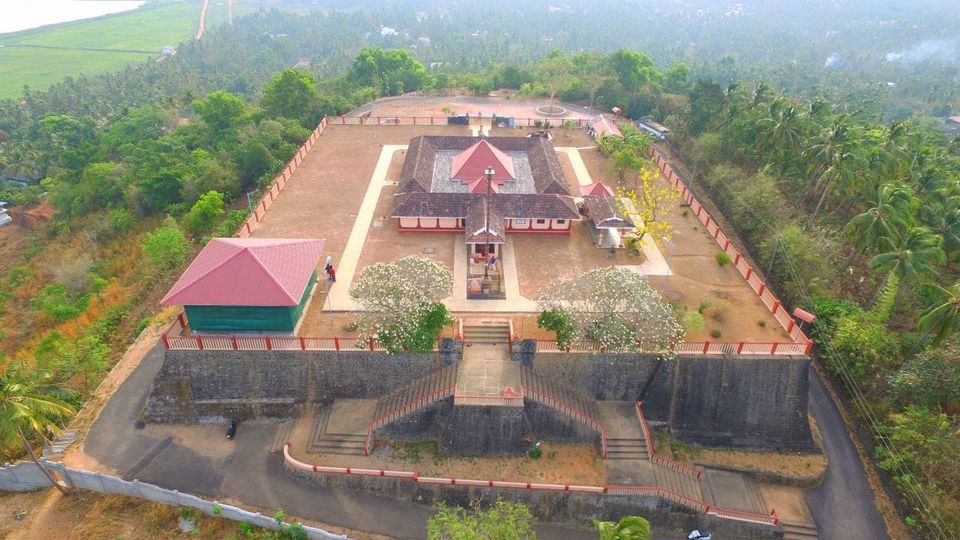

Aikkunnu Pandavagiri Temple
Legend of Aikkunnu Pandavagiri Temple
The Aikkunnu Pandavagiri Devi Temple, situated in Vangingissery village of Paralam Panchayat, is the most famous among the 108 Durga temples consecrated by Sage Parashurama in the Treta Yuga.
Legend has it that during their twelve years of exile in the forest, the Pandava princes along with their wife Draupadi resided here and performed intense penance. Thus, they received the blessings of the Goddess of all prosperity, abundance, and generosity. Furthermore, it is believed that the desires of Draupadi—who prayed for her husbands' victory in war and for the boon to outlive her husbands in life—were granted. Through the grace of the Goddess, Draupadi was able to shed her mortal frame as a wife before her husbands met their end, a boon not granted even to Goddess Sita or Rukmini. What else but the grace of our Goddess made that possible!
In ancient times, long before the Pandava princes came here to meditate, it is believed that numerous sages performed intense penance on the Pandavagiri hills for a very long period.
Having attained the blessings of the Goddess with complete fulfillment, the Pandavas later went on their way. Over time, due to neglect, the temple fell into ruin and decay. Even during the period when the temple owners themselves managed affairs, this sad state of dilapidation could not be resolved. Things deteriorated to the point where even daily rituals (poojas) could not be conducted regularly. Worship literally came to a standstill.
Continuation of the Presence of Ascetics
In the 1960s, His Holiness Swami Bhoomananda Tirtha Ji Maharaj arrived at Pandavagiri, built a small mud hut on the eastern slopes, and led a life of hard work and multi-faceted efforts for the upliftment of society. It goes without saying that this ancient, holy land of ascetics became even more blessed and divine due to the presence of Swamiji’s Narayanashrama Tapovanam and the Lokasamgraha (world welfare) activities associated with the ashram.
Sage Agastya, traveling south from the Himalayas, reached the Dandakaranya forest and was deeply distressed to see the people suffering from famine and drought. Greatly disturbed, he began to perform penance there. As he meditated, rains fell, and soon vegetation sprouted everywhere and trees burst into bloom. This is significantly recorded in Valmiki's Ramayana and is noteworthy. Undoubtedly, the penance and austerities performed there make any place holy and sacred. Penance and spiritual austerity are the remedies for any suffering or misfortune in life. Nothing else can bring the required blessings and grace quite like penance.
The Goddess Broke Her Silence
During that period, a theft occurred in the temple. One night, someone stole the silver cover (golaka) of the Goddess from the shrine. Hearing this, all the villagers, especially the devotees of the Goddess, were deeply saddened and anxious. In 1988, an astrological session (Ashtamangalya Prashnam) was conducted. In it, the misfortunes and impurities affecting the abode of the Goddess were revealed, worsening the people's grief and helplessness. The astrologers discovered that the Goddess was lying upside down and face down in her abode!
Discussing their findings with an open mind, the astrology experts noted that Sage Parashurama had consecrated the temple here in the Treta Yuga, that the Pandava princes and Draupadi had come and performed penance here in the Dwapara Yuga, and that many intense ascetics had lived here performing penance both before and after. All of this elevated the sacredness and sanctity of Pandavagiri.
These revelations helped awaken the people, inspiring them to rise up and work toward reviving this holy abode of the Goddess. It was under these distressing circumstances that the local people approached Swamiji for a solution, requesting him to restore the glory, power, and majesty of Pandavagiri.
The Procession Around Pandavagiri Hill and the Resolve of the People
Very soon, the residents of Paralam Panchayat witnessed the Giri Pradakshinam (a solemn procession around the hill led by Swamiji) and saw the people's firm resolve to restore the glory of the Goddess's abode in accordance with the traditions and heritage of Pandavagiri. With that, the village understood the urgency and gravity of the situation. They unanimously decided that Worshipful Swamiji himself should rebuild and renovate this shrine of the Goddess in line with its heritage and tradition, restoring its grandeur through rituals like re-consecration (navakaranam).
As a result, Swamiji undertook the renovation and rededication of the temple through Heritage National Trust (HNT).
Construction of the Road Leading to Pandavagiri Hill and Leveling of the Site
With remarkable foresight, Worshipful Swamiji's first step was to construct a motorable road to reach the top of the temple hill. This enabled trucks and vehicles to move materials and supplies required for the civil works at the summit.
Normally, leveling a hilltop site involves cutting down high points and excavating soil. Here at Pandavagiri, however, the exact opposite happened. Soil was brought in from around the hill to build a steep retaining wall thirty feet (10 meters) high to reclaim the upper plateau—a Herculean task. One can say this was an unforgettable achievement in the history of this land.
People witnessed the miraculous creation of a level one-acre expanse atop Pandavagiri, with a beautiful temple built right at its center! A truly unique engineering feat! During this critical phase, Holy Swamiji himself was seen working tirelessly for months, wearing a whistle around his neck from morning to evening to guide hundreds of workers. It should be remembered that back then, modern construction and earth-moving equipment like JCBs and tipper trucks were unheard of in Kerala. (Late Ammini Madhavan, a very close devotee, had recalled that due to Swamiji's swift movement across the work site, it was a truly challenging task even to find him to hand over food or water! – added by p)
Spending over fifty lakh rupees on the restoration work and building a plateau around the temple was completely mind-boggling and unimaginable. Until this miraculous creation of nearly 100 cents of land atop the hill and the reclamation of the temple grounds became a reality, there was no way for devotees to reverently circumambulate (pradakshinam) the temple.
Sahasra Kalasham Created History
In April 1995, the restoration work was completed. Following tantric rules, an 11-day Sahasra Kalasha (grand purification ritual) was conducted to revitalize the shrine. With that, the precincts of the Goddess became vibrant and divine, bestowing blessings upon her devotees and clearly bringing prosperity and peace.
Along with re-establishing the idol of the Goddess, it should be mentioned here that the installation of the Sastha (Ayyappa) idol in the sub-shrine and the erection of the Goddess's flagstaff (kodimaram) were also carried out. Thus, the Pandavagiri Devi Temple became one of the rare temples in the ancient Peruvanam village to feature a permanent flagstaff.
Connection with the Arattupuzha Devaswom Assembly and Other Celebrations
We feel joyful and grateful to share that at this very holy and rare shrine adorned with a Treta Yuga heritage, all ancient ritual practices, ceremonies, annual festivals, as well as newly evolved poojas, are religiously observed under the meticulous guidance of Sadguru Swami Bhoomananda Tirtha Ji Maharaj.
We must also add that under Swamiji's leadership, the temples at Thachanathukavu in Paralikkad (namely Bhagavati, Ayyappan, Shiva, and Vellitturutthi Mahavishnu) were renovated and revived in accordance with traditional rites. Daily worship and annual festivals were resumed there as well and have continued ever since. The re-consecration of the Dakshinamoorthy Temple at Vyasa Giri Vyasa Tapovanam and the construction and consecration of Vyasa Bhavanam also belong to this category.
According to historical records, the present idol of the Goddess at Pandavagiri Temple is over 1,500 years old. Records indicate that during the 1,433-year-old Arattupuzha annual festival, the Pandavagiri Goddess regularly participated alongside the Cherpu Bhagavati. This is indeed of great significance.
The famous ritual bath of the Goddess on the Triveni star day in the month of Thulam marks the first occasion of the year when she leaves her abode to travel to another location.
Since 2012, under the leadership of the temple priest (Tantri), 41 days of Mandala Pooja celebrations have been observed, featuring Navakam, Sreebhootabali, and Sheeveli processions.
On December 15, 2013, the auspicious day of Karthika Vilakku, Worshipful Swamiji inaugurated and dedicated a new circumambulatory pathway (pradakshina path) to the Goddess. Built with granite paving, this pathway was made possible solely by the blessings of Worshipful Swamiji and has proven to be a true boon for devotees who previously had to endure the scorching heat during circumambulation.
Observance of Draupadi Day
The Karthika festival in the month of Vishakha is believed to be the day Draupadi received the boon of Nedumangalyam (long marital bliss) and invincibility in war. Since 2015, this holy day has been observed as Draupadi Day at the temple. Offering silk cloth (red/yellow), sarees, handheld mirrors (valkannadi), and bridal accessories is said to bring immense blessings to devotees.
Karthika Vilakku
On the evening of the Karthika festival, the sacred flame (Karthika Jwala) on the pillar at the eastern entrance is lit with the prayer of universal well-being and prosperity for all—not limited just to Paralam Panchayat or the state of Kerala. It is a grand sight to see hundreds of devotees eagerly waiting at the temple with oil to fill the lamps. After the evening worship (Deeparadhana), devotees are given a coin and half a coconut as the Goddess's prasadam to bring good fortune and abundance to their homes.
Pongala Festival, Pushpabhishekam, and Kalabhabhishekam
The Pongala festival conducted in March, featuring the heartfelt participation of hundreds of devotees, is a spectacular sight. Equally grand ceremonies take place over the 41-day Niramala (lighting decorative lamps around the temple walls), culminating on the final day with Kalabhabhishekam, where the idol of the Goddess is anointed with fragrant sandalwood paste. In the sub-shrine, Lord Dharma Sastha is offered floral anointment (Pushpabhishekam) on the first day of the 41-day Mandalam season, concluding on the first day of the Makaram month with Vasodhara and Navabhishekam performed with deep devotion. Next, to mark the Consecration Day (Pratishtha Dinam) in the month of Medam, a grand procession featuring five majestic elephants carrying the Goddess is held during the Poojyam star hours, accompanied by Panchavadyam and Panchari Melam from the foot of the banyan tree at the southern entrance up to the temple gates. Food (prasadam) is then distributed to everyone.
Prayers at the Ancient Draupadi Rock
The shrine located on the hill peak originally lacked space in front, and there was no path to walk around the temple. Worshipful Swamiji decided to reclaim the land by filling in soil over thirty feet deep. As a result, nearly 100 cents (one acre) of land in front was transformed into a proper pathway. Although ancient rocks and stones were submerged under the soil during the filling and reclamation process, a single large rock survived the filling work and protruded at the top.
Devotees believe (and their experiences attest) that anyone standing on that rock (which holds ancient heritage) facing northeast to pray to Goddess Parvati and Lord Parameshwara residing in the Himalayas will have all the desires of their heart fulfilled.
Special Rites and Offerings
The compassionate Goddess here bestows prosperity on those who worship her and blesses women with a happy married life, just as she granted Draupadi marital longevity and victory in war. Devotees firmly believe that whatever they pray for here will be granted in life. Thus, the Goddess's grace and timely blessings hold a cherished place in the minds of all devotees.
Among the various offerings (vazhipadu) that can be presented to the Goddess, the most popular and attractive are the Swayamvara Pushpanjali for marriage, offerings for marrying a chosen partner, and offerings for eternal marital companionship (blessings to outlive one's husband). These are conducted regularly and continue to gain renown day by day.
The blessings bestowed by the Goddess upon the community following the renovation and revival of the Pandavagiri Devi Temple are boundless. As a result of performing Thrikala Pooja here, many have been blessed with the fortune of outliving their husbands. Similarly, those who performed Thrikala Pooja seeking children have been blessed with off-spring. Many have also earned the Goddess's grace by conducting Annadanam (feeding people) here. Offering raw rice to the Goddess is a famous and highly sought-after traditional rite for curing stomach ailments and for conceiving children.
Another major offering is woven coir ropes, presented for relief from head ailments, promoting luxurious hair growth, and curing respiratory problems. Placing a brass vessel (uruli) upside down as an offering for childless couples is another widely renowned practice here.